Thirty plus pieces. Five that changed everything.
A personal selection of the most influential objects in the collection.
The $25 chip that started everything
This is where everything begins. Without the 6502 at $25, there is no Apple I, no Apple II, no Commodore 64, no Nintendo NES. It is the chip that democratised computing by making it economically accessible to anyone — including a young Wozniak who could afford one with his own savings.
Before the 6502, microprocessors cost hundreds of dollars and lived exclusively inside corporations. After it, a teenager in a garage could buy one, wire it up, and write software. The entire personal computer revolution of the 1970s and '80s follows directly from that single fact. Every other piece in this collection exists because Chuck Peddle and his team decided that computing should be cheap.
The best-selling personal computer of all time
The C64 is here for two reasons that are equally important. The first one is historical: with approximately 17 million units sold, it is the best-selling single computer model in history, and it brought real computing power into homes that could never have afforded an Apple II. In Europe especially, it defined what a home computer was for an entire decade.
The second reason is personal. This museum exists because of the C64. It was the first computer in this collection, the machine that triggered the curiosity — "how can this tiny box do all these amazing things?" — that led to everything else. Without that moment, there is no programming, no university, no career, no museum. The C64 is not just historically significant. It is the origin of the story.
Still alive. Still programmable. Still connected.
The Macintosh Classic earns its place not for what it was in 1990, but for what it still is in 2025. It is the most philosophically interesting piece in the collection: a machine built 35 years ago that can still be programmed, still connected to a modern network, still used to write and compile real software.
In an era of planned obsolescence, cloud dependency, and hardware sealed against repair, the Classic stands as proof that well-designed things last. The fact that THINK C still compiles, that MacTCP still connects, that the Toolbox ROM still responds — this is not nostalgia. It is a statement about what quality means. No other piece in this collection makes that argument more powerfully.
The Macintosh Classic, introduced in 1990, is a perfect bridge between the original Macintosh of 1984 — from which it inherited its soul — and the modern Mac. In the User Interface of System 7.1 we can already recognise the seeds and the philosophy of what would become macOS decades later. Its little 9" display looks endearing; the whole machine invites you to touch it, move it around, play with it like an old friend.
The day an entire industry became obsolete
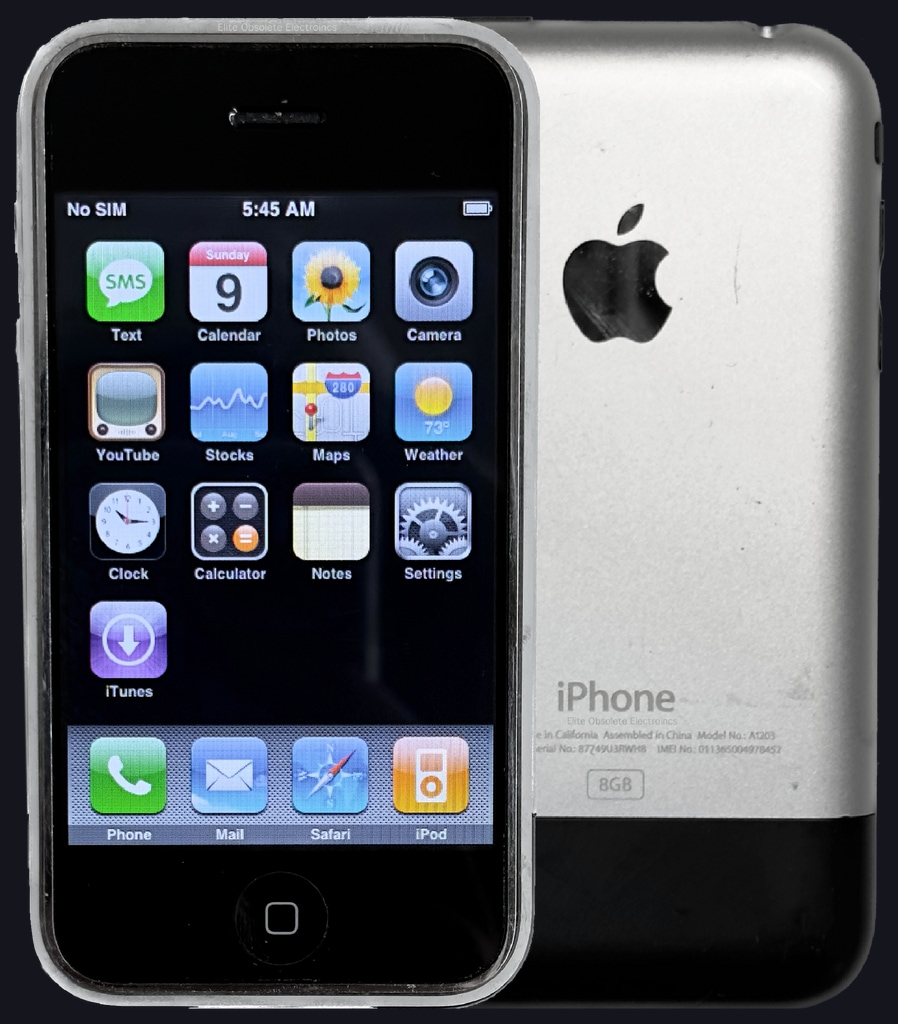
January 9, 2007 is one of the clearest before-and-after moments in the history of technology. Nokia held 40% of the global mobile market. BlackBerry owned the enterprise. Windows Mobile was the platform of choice for smartphones. Within five years, all three were effectively finished. One product, one afternoon, one presentation.
The iPhone 2G is here because it is the purest example of disruption in this entire collection — not incremental improvement, but the complete redefinition of a category. It didn't just make a better phone. It made every existing phone feel like it belonged to a different century. And it proved, once and for all, that the most dangerous competitor is not the one who plays your game better, but the one who changes the rules entirely.
Moreover, it is the witness of one of the most memorable product presentations ever made by Steve Jobs.
1st generation · The product that changed the music industry
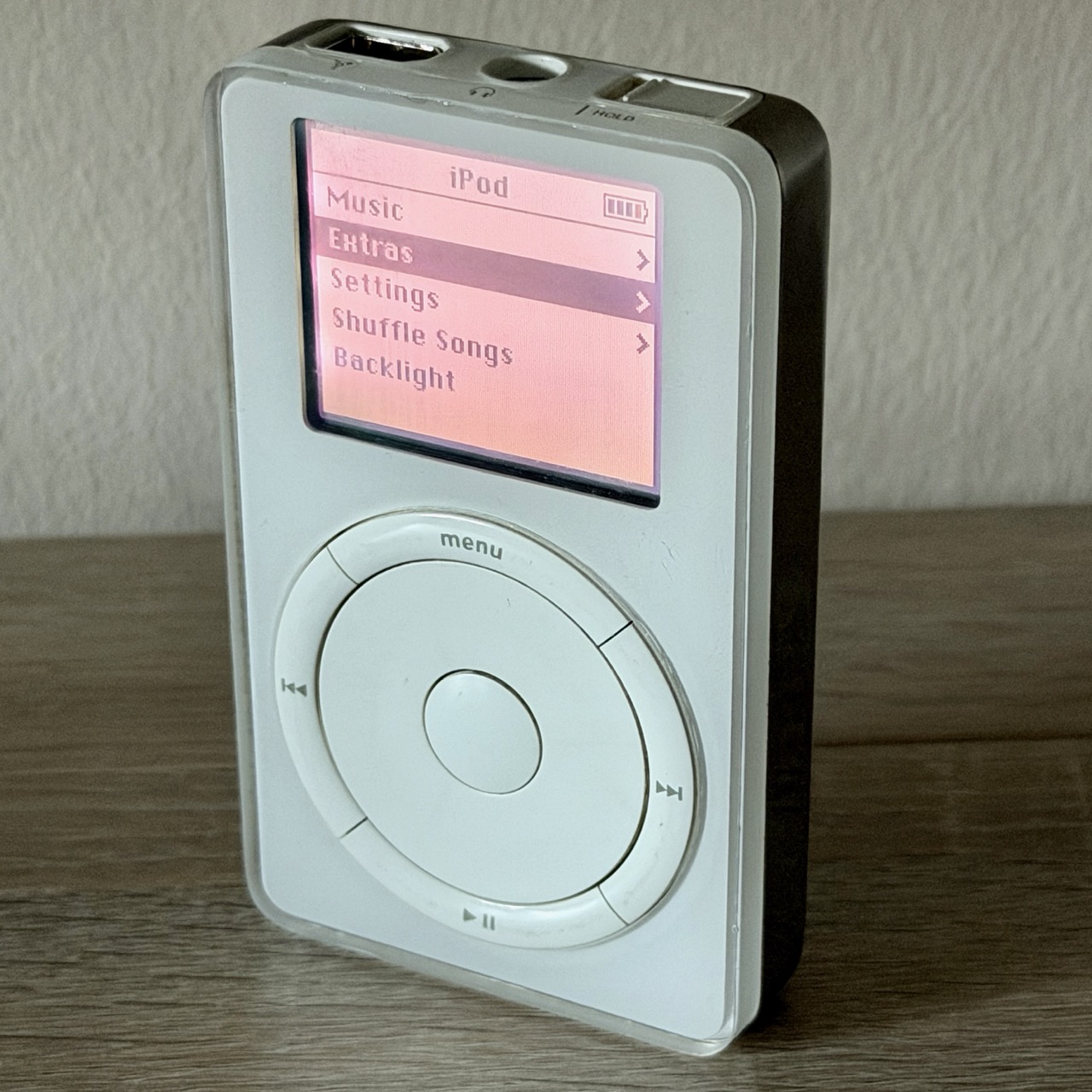
In January 2007, Steve Jobs opened the Macworld keynote by saying Apple was dropping the word "Computer" from its name. Apple Computer, Inc. was becoming Apple Inc. The reason was a seed put in everyone's pocket: the iPod. A device that had nothing to do with computers — and yet had transformed the company more than any Mac ever had.
The original iPod of 2001 was the first proof that Apple could define an entirely new product category, dominate it, and use it to reach people who had never bought a Mac. It was the bridge between the computer company of the 1990s and the consumer electronics giant of the 2000s. Without the iPod there is no iTunes Store, no iPhone, no App Store. It is the quiet pivot on which the entire second half of Apple's story turns.
1st generation · A category that didn't exist before
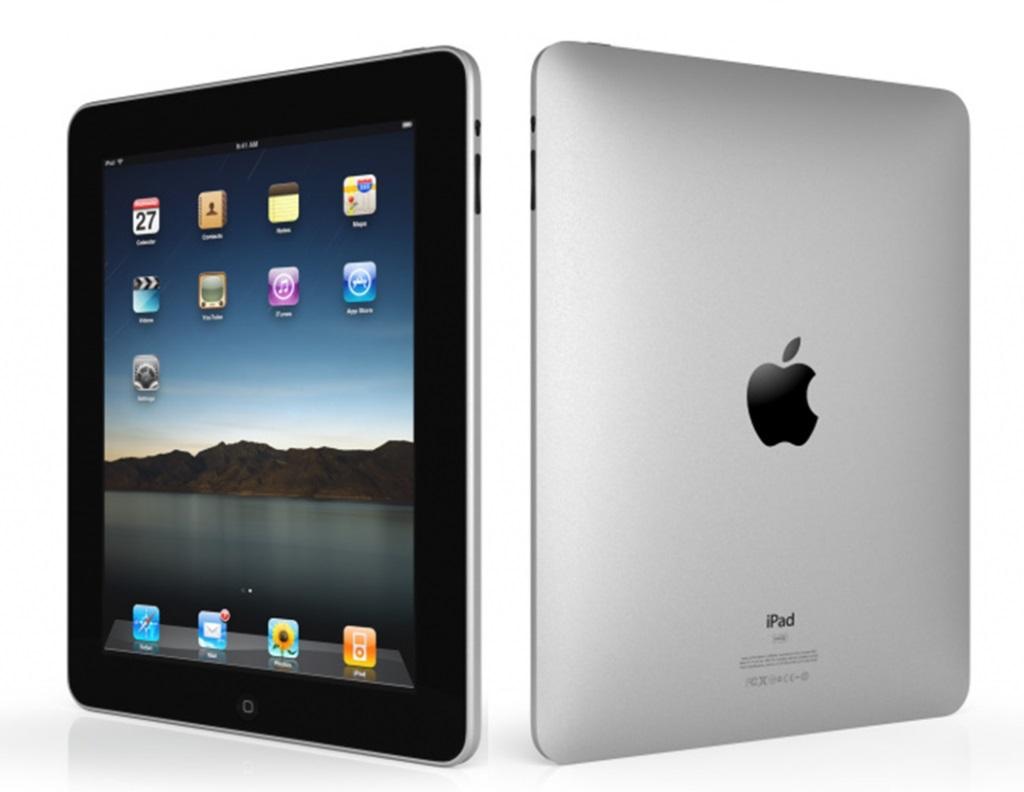
This is the first product out from the top five, but I felt like I had to spend a few words and not leave it off this page. Every other product in this Hall of Fame improved on something that already existed. The iPad did not. There was no tablet market worth speaking of before January 2010 — Microsoft had tried for a decade with Tablet PC and failed. The iPad succeeded because it asked a different question: not "how do we put Windows on a touchscreen?" but "what would a computer be if we designed it for how people actually live?"
The answer was a device you hold like a magazine, use on a sofa, hand to a child, carry without a bag. A computer that disappears into its own use. It created a new category, proved the post-PC thesis, launched the A-series chip dynasty that would eventually become Apple Silicon — and it did all of this in a first version that already felt completely finished. That is the hardest thing to do in product design.
The most beautiful computer ever designed
The iMac G4 does not appear in the top five because the top five is about influence and disruption. But there is a different question this collection invites, and for that question the G4 has no rival: what is the most beautiful machine here? The answer is immediate and unanimous.
Steve Jobs and Jony Ive's guiding principle for this design was "each element has to be true to itself." The hemisphere contains all the computing hardware — so it is round and solid. The flat panel display is light and precise — so it floats on a chrome arm, weightless. The arm is a mechanical marvel: a perfectly balanced joint that lets you move the screen to any position with two fingers and holds it there without a single screw to tighten. It is engineering in service of poetry.
The iMac G4 was also the first flat-panel display in a consumer desktop computer — a transition from the heavy CRT era that changed the physical relationship between people and their screens. But the technical significance is almost beside the point. What matters is that this machine is genuinely, unambiguously a work of art. MoMA acquired it for its permanent collection. That verdict stands.
A declaration of love between technology and the liberal arts. There has been nothing quite like it before or since.
"Each element has to be true to itself."
— Steve Jobs and Jony Ive, on the design of the iMac G4